Brawl Stars Review: Is This the Best Quick Competitive Mobile Game?
Brawl Stars isn’t coasting on nostalgia. With revenue up nearly 50% in March 2026, Supercell’s arena brawler still has serious momentum. But do its three-minute matches, ranked depth, and live-service grind make it mobile’s best quick competitive game?
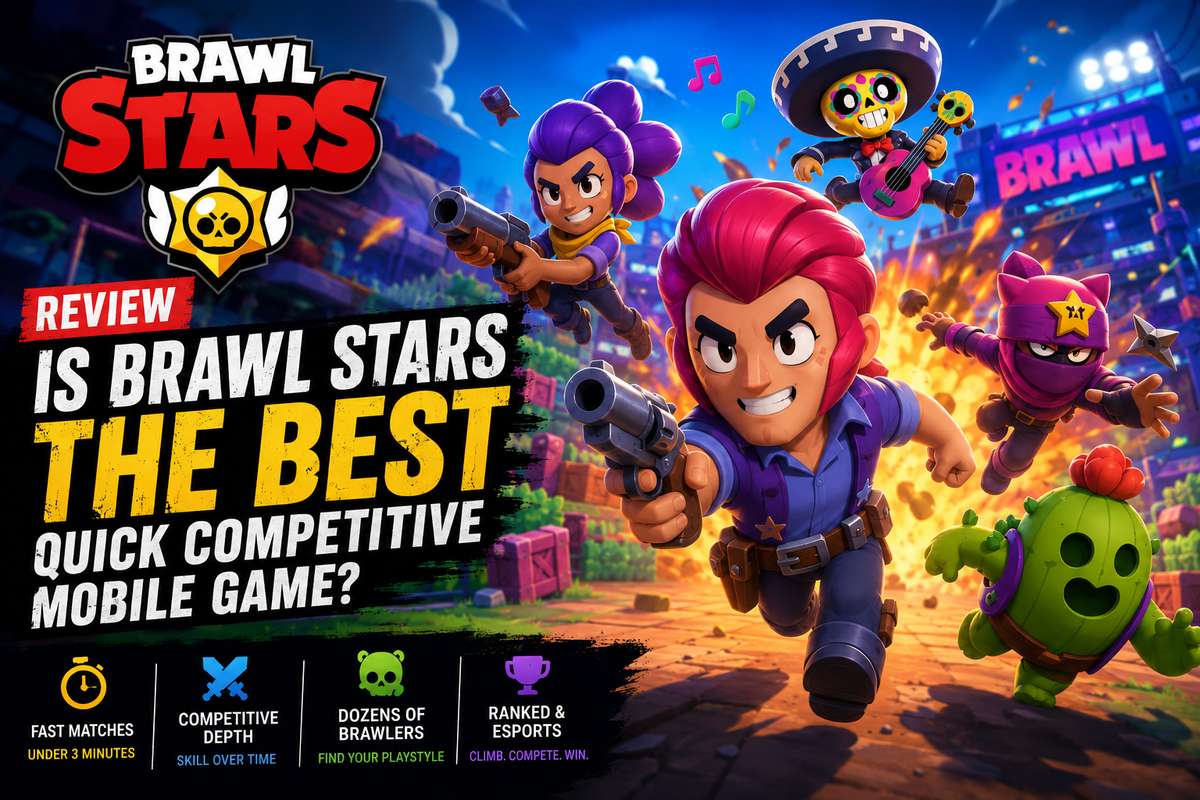
Brawl Stars should be past its prime. It launched globally in 2018, it has been dissected by casuals, ranked grinders, esports teams, YouTubers, skin collectors, angry Redditors, and every kid with a phone at lunch. Yet here we are in 2026, and Supercell’s scrappy top-down brawler is not fading. PocketGamer.biz reported that Brawl Stars banked $48.6 million in March 2026, up 46.8% from February, making it the 19th top-grossing mobile game worldwide across App Store and Google Play estimates. That is not nostalgia. That is momentum.
The obvious question, then, is no longer whether Brawl Stars still matters. It does. The sharper question is whether it has become the definitive quick competitive game on mobile. The answer is close enough to make its rivals uncomfortable.
Brawl Stars’ genius is that it understands the phone better than almost anything in its lane. Supercell describes it as fast-paced 3v3 and 5v5 PvP, with modes built for matches “in under three minutes,” and that remains the core of its identity. This is not a console game crammed onto glass. It is a mobile-native competitive game where a bad match is over before your irritation can become commitment, and a great match immediately begs for one more queue.
That brevity matters. Clash Royale has always had the elegant pressure of a duel, Marvel Snap has the brainy snap-and-retreat rhythm of a card shark, Pokémon Unite condenses MOBA structure into a more digestible team format, and Mobile Legends: Bang Bang offers the closest thing to a full-fat mobile MOBA for players who want lanes, rotations, and proper macro. But Brawl Stars hits a rarer middle point: it feels mechanical without demanding a controller, tactical without requiring a 25-minute match, and social without becoming fully hostage to voice chat.
At its best, Brawl Stars is competitive junk food made with surprising craft. Movement, range discipline, ammo counting, super cycling, lane pressure, bush control, wall breaks, gadget timing, and matchup awareness are all visible in seconds. The skill expression is not hidden behind build orders or deck math. It is in the tiny stutter-step that dodges a Piper shot, the delayed super that turns a Brawl Ball push, the thrower angle that makes a safe lane suddenly unplayable, or the restraint to not auto-aim when panic says you should.
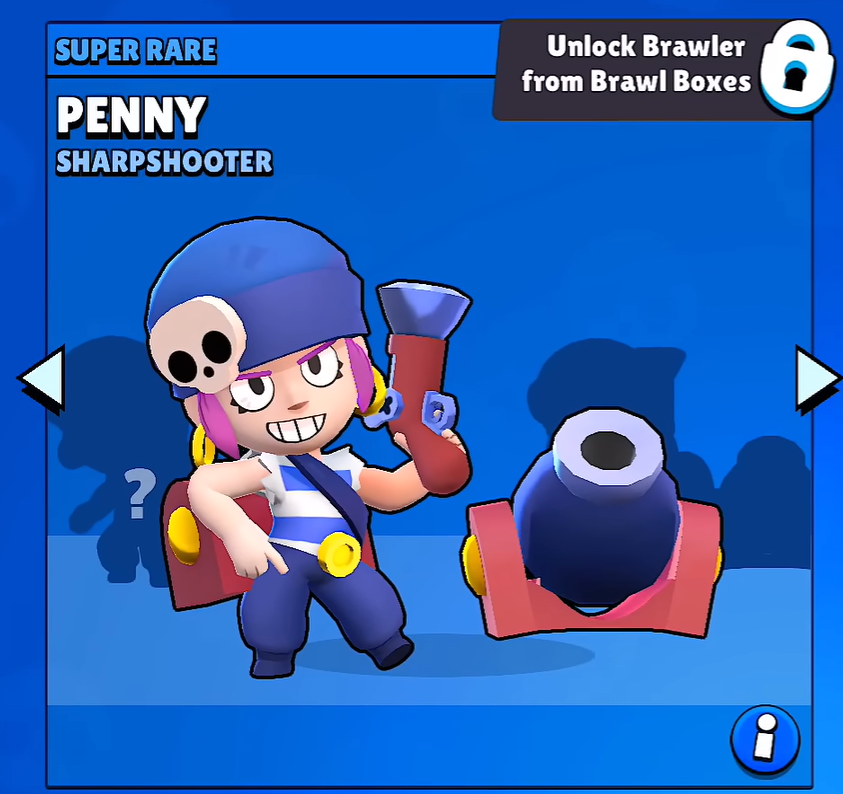
The brawler roster is the game’s engine and its ongoing balance headache. “Dozens of Brawlers” undersells how varied the cast feels in practice, because the best designs are instantly readable and tactically distinct: snipers who punish sloppy movement, tanks who change the geometry of a fight simply by existing, assassins who feast on isolated mistakes, supports who tilt an entire lane through sustain or utility, throwers who turn walls into weapons. Even when a brawler concept is goofy, the battlefield implications are usually serious.
The visual style helps more than it gets credit for. Brawl Stars is loud, toy-like, and borderline obnoxious in screenshots, but in motion its arcade readability is a competitive advantage. You can parse threat zones, projectile paths, ability effects, and character silhouettes on a cracked phone screen in bad lighting. The game looks childish in the way a great arcade cabinet looks childish: exaggerated because it has to communicate instantly. Mobile competitive games die when visual noise muddies intent. Brawl Stars gets messy, especially with newer cosmetics and effects, but its base language remains unusually clean.
The mode rotation is where Brawl Stars earns its longevity. Gem Grab is still the closest thing the game has to a thesis statement: map control, greed, comeback pressure, and one catastrophic death rolled into a tiny match. Brawl Ball is the crowd-pleaser, simple enough for anyone to understand and deep enough for coordinated teams to choreograph terrifying pushes. Heist is blunt but satisfying when the meta is healthy. Knockout and Bounty reward patience and precision. Showdown remains the messy side alley, fun in bursts, less convincing as a serious competitive format because teaming, third-partying, and spawn variance can undercut the purity of the fight.
That last point matters, because Brawl Stars is not equally excellent everywhere. Its best modes are structured 3v3 modes. Its weakest competitive moments come when it leans too hard into chaos, limited-time gimmicks, or power systems that temporarily warp the game around novelty. Supercell is brilliant at jolting attention back into Brawl Stars, but not every jolt improves the competitive texture. Sometimes the game feels like it is trying to be an esport and a toy store promotion at the same time.
Ranked play has improved, but it is still not the clean, ruthless ladder Brawl Stars deserves. Supercell’s 2025 ranked rework explicitly aimed to make Ranked more competitive for skilled players, increase engagement, improve rewards, keep seasons fresh, and support esports monetization through the Pro Pass. That transparency is useful, because it exposes the tension. Ranked is not just a ladder. It is a retention system, a reward track, an esports funnel, and a monetization surface.
The upside is that ranked now gives players more reason to care beyond trophies. Drafting, bans, mode knowledge, and brawler depth matter. You cannot simply one-trick your way through every scenario without eventually running into hard counters or map-specific problems. At higher levels, Brawl Stars becomes a game of controlled aggression: when to hold lane, when to collapse, when to trade your life for objective value, when to conserve ammo, and when to accept that the enemy comp has one cleaner win condition and you need to disrupt it immediately.
The downside is matchmaking. Not uniquely bad, not uniquely cursed, but inconsistent in the way nearly every fast team-based mobile game is inconsistent. Solo queue can feel like a psychological experiment. The matchmaker has to solve rank, brawler availability, party size, region, latency, mode, map, and role balance in a game built around near-instant sessions. It often does a good enough job. It also regularly produces matches where one player clearly wandered into the wrong room.
Balance is the other permanent bruise. Brawl Stars has a large and constantly expanding roster, plus gadgets, star powers, hypercharges, newer systems, and map interactions. Supercell does tune aggressively, with official 2026 release notes showing frequent buffs, nerfs, bug fixes, and targeted changes to brawlers such as Sirius, Najia, Damian, Crow, Leon, Grom, Mortis, and others. That cadence is healthy, but it also means the meta can feel like wet cement. A brawler can dominate long enough to poison a season’s mood, then get pulled down just as players have invested resources into them.
Against its rivals, Brawl Stars wins on feel. Clash Royale is cleaner strategically and more elegant as a one-on-one competitive object, but its card-leveling baggage has long made fairness a sore point. Marvel Snap is faster to mentally parse and probably the better “one hand, one brain cell still free” competitive game, but it is not an action game, and its collection model shapes competition in a different way. Pokémon Unite and Mobile Legends offer more traditional team strategy, but they ask for longer sessions and more tolerance for MOBA frustration. Brawl Stars gives you the hit of a team fight, the satisfaction of a mechanical outplay, and the sting of a ranked loss in a fraction of the time.
That does not make it shallow. It makes it compressed. The best Brawl Stars players are not just twitchier. They understand tempo. They know that a super held for five seconds can be more valuable than a super spent for damage. They know when to pinch, when to bait, when to switch lanes, when to die late, and when to take space without firing. It is a game where the scoreboard often lies. The winning play is frequently the one that creates pressure no stat screen respects.
Monetization is where the verdict gets more complicated. Brawl Stars is free to download and play, but its store listings plainly note that some items can be purchased for real money, including random items. The modern progression suite, Brawl Pass, Brawl Pass Plus, Starr Road, drops, cosmetics, resource bundles, and ranked-related reward structures, is more legible than the old loot-box era, but not clean enough to call frictionless.
Is it predatory? That is too blunt. Is it perfectly fair? Absolutely not. Brawl Stars is generally more tolerable than many mobile competitors because skill still screams through the noise, and because short matches make losses easier to absorb. But progression matters. Access to upgraded brawlers, gadgets, star powers, hypercharges, and enough roster depth for ranked drafting is not cosmetic. A newer or free player can compete, but they are not experiencing the same strategic freedom as a veteran or spender.
The paid tracks are not merely decorative accelerants, either. The Pro Pass was framed by Supercell as a four-month ranked progression system tied to major esports events, with free and paid tracks and paid benefits including instant progression and increased Pro Pass XP. That is clever live-service design, and also a reminder that Brawl Stars’ competitive ecosystem is wrapped around monetized motivation. The game is not pay-to-win in the cartoonish sense. It is pay-to-progress, pay-to-broaden-options, pay-to-reduce-friction. In a draft-heavy competitive game, that distinction is real, but it is not harmless.
Still, the reason Brawl Stars survives this criticism is that the matches remain electric. A bad monetization screen can make you roll your eyes. A perfectly timed team wipe in Hot Zone can make you forget it existed. That push and pull defines the game in 2026: brilliant competitive design surrounded by an increasingly elaborate live-service machine.
The strengths are obvious. Brawl Stars is fast without feeling disposable. Its controls are among the best in mobile action. Its best modes are clean, watchable, and expressive. Its roster is charismatic and mechanically varied. Its esports ambitions are no longer theoretical, with the 2026 Brawl Stars Championship listing total tournament prizing of $2 million and World Finals planned for November. It is one of the few mobile games where casual, ranked, and spectator appeal actually overlap.
The weaknesses are just as real. Balance swings can be exhausting. Ranked matchmaking can punish solo players. Progression still pressures your wallet and patience. Some modes are much better than others. Visual effects and systems creep threaten the elegant readability that made the game special. And for all its competitive depth, Brawl Stars sometimes undermines itself by chasing spectacle when it should trust the purity of its own fights.
So, is Brawl Stars the best quick competitive mobile game available?
Yes, with an asterisk sharp enough to draw blood. If “quick competitive” means the best blend of short sessions, mechanical skill, team tactics, mode variety, mobile-native controls, and long-term competitive relevance, Brawl Stars is the current benchmark. Clash Royale may be the tighter duel. Marvel Snap may be the better pocket card game. Pokémon Unite and Mobile Legends may scratch the fuller MOBA itch. But none of them combine immediacy, action, depth, and replayability quite like Brawl Stars.
It is not the fairest. It is not the cleanest. It is not always the best balanced. But when a three-minute match can give you a comeback, a throw, a clutch, a draft lesson, and a reason to queue again, the argument starts to feel academic.
Rating: 9/10