Gossip Harbor Review: A Cozy Café Mystery With a Cash Register Behind the Counter
Gossip Harbor looks like a cozy café story about rebuilding Quinn’s restaurant and unraveling Brimwave Island gossip. But beneath the charm, its merge board, energy limits, rare drops, and event pressure turn comfort into a carefully monetized grind.
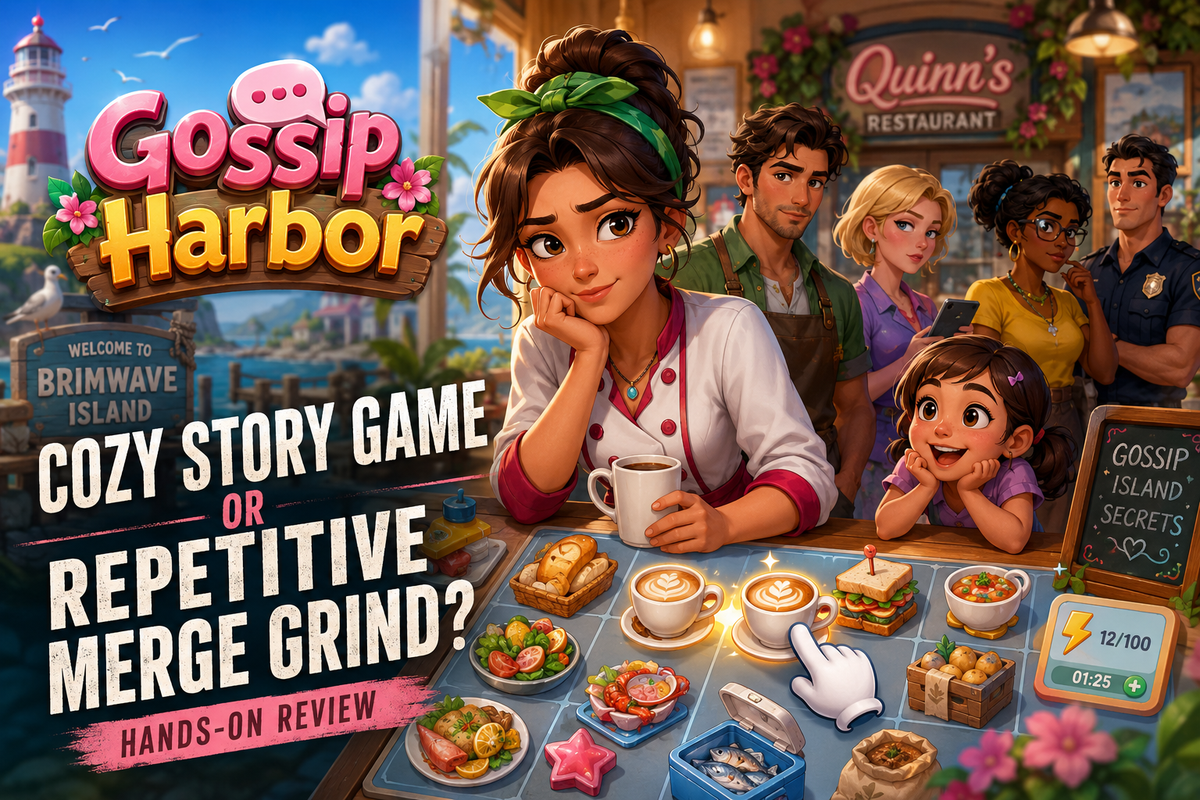
Microfun’s merge-story hit is charming, compulsive, and far too good at turning comfort into friction.
Gossip Harbor does not look like a $93 million-a-month game at first glance. It looks like a warm little beachside diversion: a ruined restaurant, a frazzled chef, a small town with too much time on its hands, and a merge board full of coffee cups, bread baskets, seafood platters, floaties, and other pastel clutter. Yet AppMagic’s April 2026 estimates put Gossip Harbor at $93.1 million in monthly revenue, down only slightly from a record March, while Google Play currently lists it as a top-grossing puzzle game. That gap between appearance and reality is the whole game in miniature. Gossip Harbor sells coziness, but its true craft is momentum.
The setup is pure mobile melodrama, and I mean that as a compliment. Quinn Castillo’s life on Brimwave Island has collapsed into one of those catastrophes only a story game can deliver with a straight face: divorce, sabotage, secrets, a restaurant in need of restoration, and the nagging question of who is trying to ruin her life. The official pitch is direct about the ingredients: merge dishes, restore Quinn’s restaurant, build relationships, and uncover the town’s buried gossip.
In practice, Gossip Harbor is less about one grand mystery than the steady accumulation of small, soap-operatic nudges. Quinn is not just a restaurant owner. She is a parent, an amateur sleuth, an ex-wife, a friend, and occasionally the only person in Brimwave capable of asking the obvious question. Her ex-husband Colton hangs over the early story as a messy suspect and co-parent. Harrison, the local fisherman and one of Quinn’s old friends, brings the slow-burn romantic tension. Amala and Sam keep the social circle moving, while Mark’s police-officer presence gives the drama its procedural seasoning. Quinn’s daughter Olivia is the game’s most reliable reminder that the story is meant to be soft even when the plot is dealing in arson, poisoning, and betrayal. Fan documentation describes Quinn as both a restaurateur and detective, with her burned restaurant and poisoned food forming the backbone of the early mystery.
The writing works best when it lets Brimwave feel like a town rather than a conspiracy board. A throwaway aside about someone’s love life, a pointed comment from Carmen, a moment where Quinn tries to keep things normal for Olivia, these are the beats that make players care. The dialogue is rarely elegant, and it sometimes has the slightly over-explained rhythm common to live-service story games, where every character must restate the emotional stakes before the next renovation task unlocks. But it understands the value of a good raised eyebrow. The “gossip” in Gossip Harbor is not merely branding. It is the glue that keeps the player tapping through another order.
That said, the pacing is inseparable from the merge economy, and this is where the game’s cozy promise starts to wobble. Story progress costs coins. Coins come from completing customer orders. Orders require merged items. Merged items require energy, board space, generator cooldowns, and patience. The narrative may ask you to solve a mystery, but the board asks you to make one more sandwich.
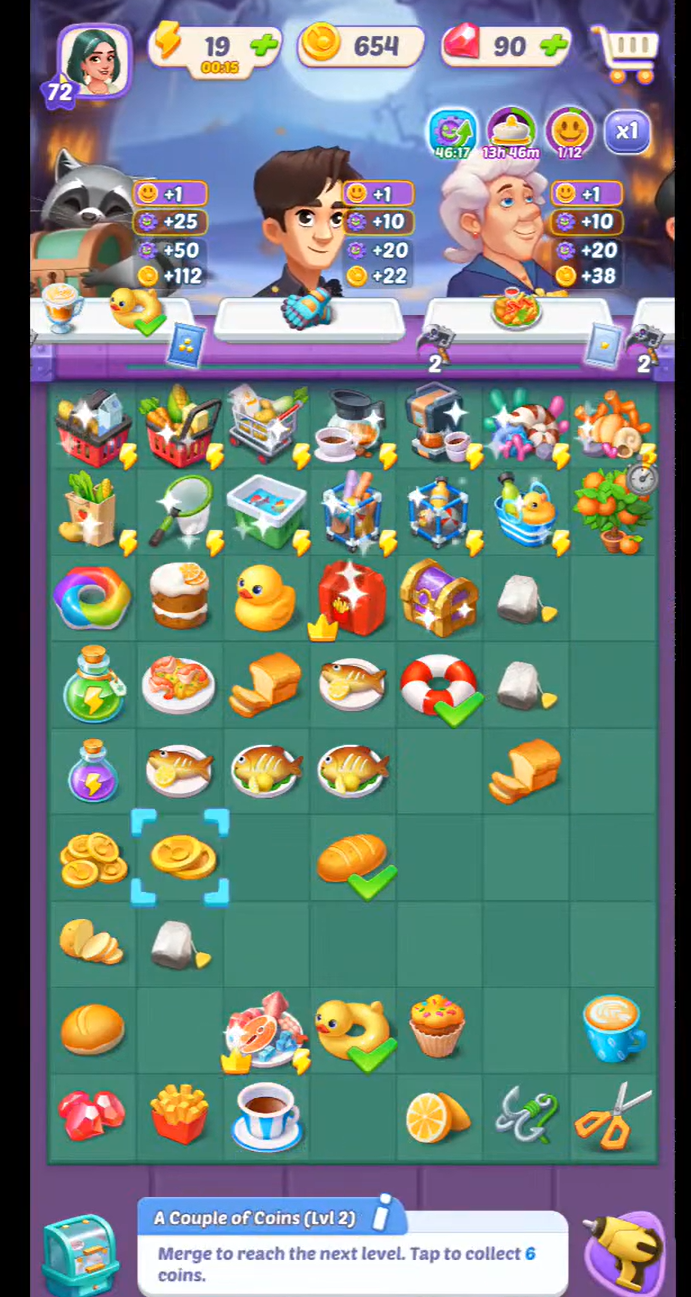
The core mechanic is familiar merge-two design. Tap a generator, spend energy, produce low-level items, merge two matching items into a higher-level item, and keep climbing until you can satisfy an order. Coffee and tea generators spit out drinks. Grocery chains produce bread and potato items. Seafood generators feed fish chains. Storage-related generators can lead to duckies, floaties, and swimming gear. The wiki’s item lists are sprawling enough to make the game feel less like a café and more like a supply-chain simulator wearing a sun hat.
Early on, the loop is genuinely satisfying. The board is readable. The orders are modest. Two coffees become a better coffee. A few bread merges become something presentable. You cash in, collect coins, watch Quinn fix another corner of the restaurant, and get a few lines of town drama as dessert. The pleasure is tactile and immediate. Gossip Harbor understands that merging is not just a puzzle action. It is tidying. It is making a mess resolve into neat little icons.
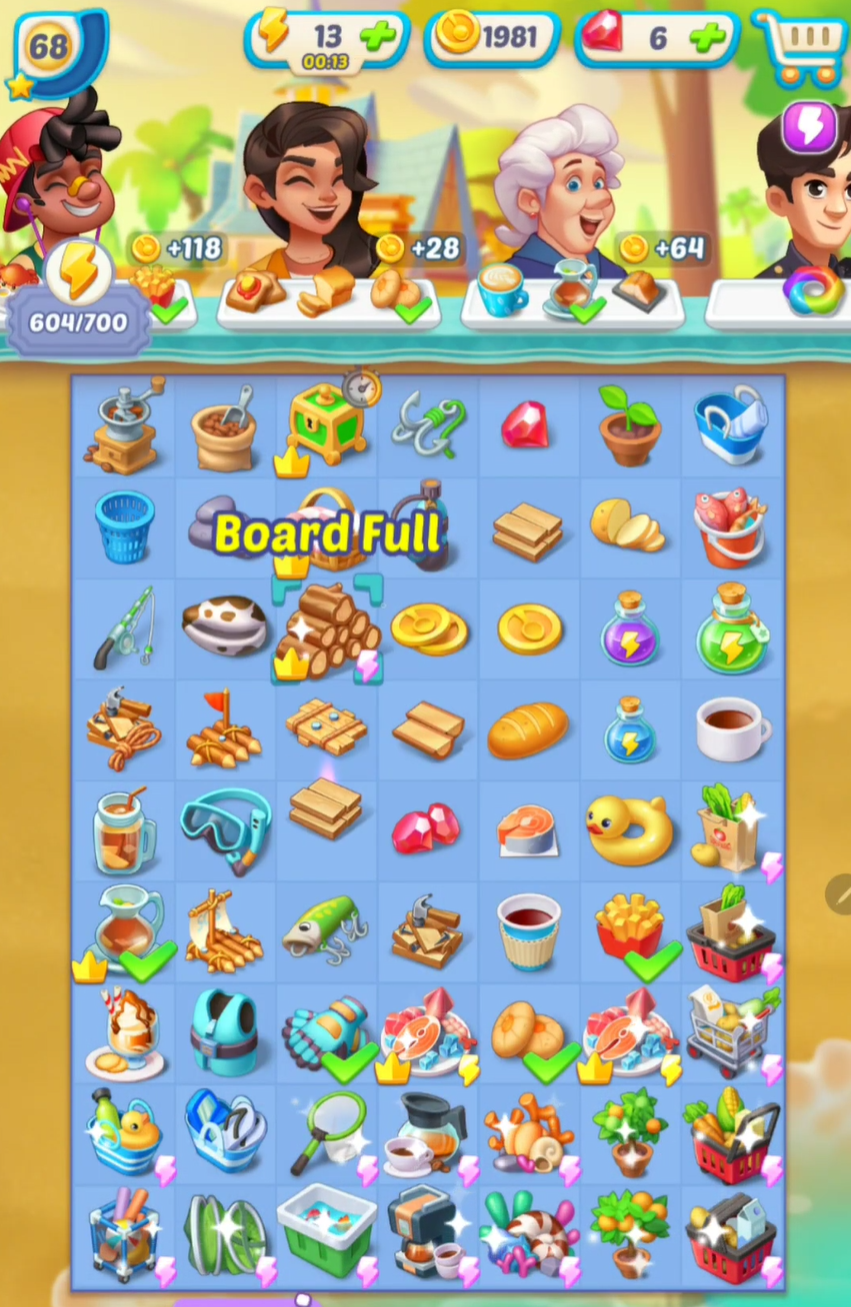
The mid-game is where the design becomes more interesting and more suspect. The board starts to crowd. Generators produce side chains you did not ask for but cannot quite throw away. A seafood order may ask for something that takes longer than the reward feels worth. A bread chain suddenly forks into potatoes, and potatoes are the kind of rare-drop item that makes you stare at your board with the dead-eyed focus of a person reorganizing a garage at midnight. Deconstructor of Fun’s analysis notes the exponential cost of high-level merge chains and points out how rare drops can make the true energy cost of an item hard to grasp while playing.
Late-game Gossip Harbor is less cozy café and more inventory triage. The game does offer strategy. Keeping generators grouped, saving energy bottles until they can be merged, timing when to claim rewards, and using boosted generators intelligently all matter. There is a real rhythm to deciding whether to chase the big seafood order, clear quick coffee requests, or preserve space for an event chain. When the board is humming, Gossip Harbor has the same appeal as a well-packed suitcase. Everything has a place. Everything is almost under control.
But “almost” is the operative word. The friction is not accidental. Energy is the main leash. Standard play burns through it quickly, and once the tank is empty, the game becomes a waiting room with decorative wallpaper. Timers slow generators. Storage space is precious. Bubbles and offers tempt you with just enough relief to make refusal feel inefficient. The game includes rewarded video ads rather than constant forced ads, which is preferable, but even optional ads become part of the daily calculus when they are tied to energy or valuable items. Deconstructor of Fun describes Gossip Harbor as primarily monetized through in-app purchases, with rewarded videos as the only ad format and a likely supplemental revenue source.
The most telling design choice is how often Gossip Harbor layers events on top of ordinary play. Seasonal tracks, order events, coin races, decoration events, and recent experiments like Norman’s Monster Hunt all feed off the same core loop. GameRefinery described Norman’s Monster Hunt as a hybrid PvE event that blended match-three-style interactions with merge-based progression, with players earning moves through core gameplay. On paper, that integration is elegant. You are never truly “leaving” the game to play an event. In practice, it means nearly everything points back to spending more energy.
This is where the $93.1 million figure matters. It is not just proof that Gossip Harbor is popular. It is proof that its frictions are tuned with frightening competence. A game does not reach that scale on charm alone. It gets there by converting impatience, attachment, completionism, and event pressure into repeat spending. The economy does not need every player to pay. It needs enough players to pay often, and a smaller slice of high spenders to treat energy packs, season passes, storage expansions, and limited-time shortcuts as the cost of staying current. When a cozy game is this commercially successful, the question is not whether monetization is present. The question is whether the experience has been designed around moments of discomfort that money can smooth out.
Gossip Harbor has, unmistakably. That does not make it cynical from top to bottom. The craft is real. The art is clean and readable. The characters are sticky. The merge feel is better than many competitors because orders are refreshed in ways that keep sessions from becoming entirely blocked, and the game is smart about giving you small wins even when larger goals are distant. Deconstructor of Fun notes that new orders can appear after cooldowns, giving returning players easier goals alongside harder leftover requests, which helps each session feel productive.
Still, the “cozy” label becomes harder to defend the longer you play. Cozy games usually let you settle in. Gossip Harbor lets you settle in, then sells you a cushion, then times how long you sit on it. The restaurant restoration and character scenes are pleasant rewards, but they are rationed behind an increasingly demanding production board. The better the story gets at making you care about Quinn, Olivia, Harrison, Sam, Mark, and the rest of Brimwave, the more leverage the economy has over you.
So who should play it? If you like merge games as daily rituals, enjoy character-driven mobile melodrama, and can walk away when energy runs out, Gossip Harbor is one of the strongest examples of the form. It is ideal for players who want a 10-minute check-in with a little narrative sugar and a board that always has something to optimize. If you are completionist, impatient, allergic to battle-pass-style event pressure, or prone to spending “just once” to clear an annoying order, approach with caution. This game knows exactly how to make “just once” feel reasonable.
The verdict: Gossip Harbor is a cozy story game in presentation, but a repetitive merge grind by design. Its charm is not fake, but it is instrumentalized. Brimwave is inviting, Quinn’s drama is easy to follow, and the board can be wonderfully satisfying. Yet the further you go, the clearer it becomes that the game’s comfort is built around scarcity. It wants to soothe you, then interrupt the soothing, then offer to sell it back.
Pros
- Strong small-town soap opera hook with a likable central cast
- Satisfying early and mid-game merge flow
- Smart event integration that keeps sessions feeling active
- Clean art, readable item chains, and appealing restaurant restoration
Cons
- Energy friction becomes the dominant late-game feeling
- Board management can shift from strategic to cramped
- Event pressure constantly nudges spending
- Story pacing is too often hostage to repetitive order grinding
Score: 7/10
A polished, addictive, often charming merge-story hit, but not an innocent one. Play it for the gossip. Leave when the harbor starts billing by the tap.