Kingshot Review: A Crown Polished for Whales
Kingshot looks like a top-grossing strategy contender, but beneath the medieval polish is a familiar mobile 4X machine: timers, alliances, hero upgrades, and monetized impatience. There is strategy here, but the grind wears the crown.
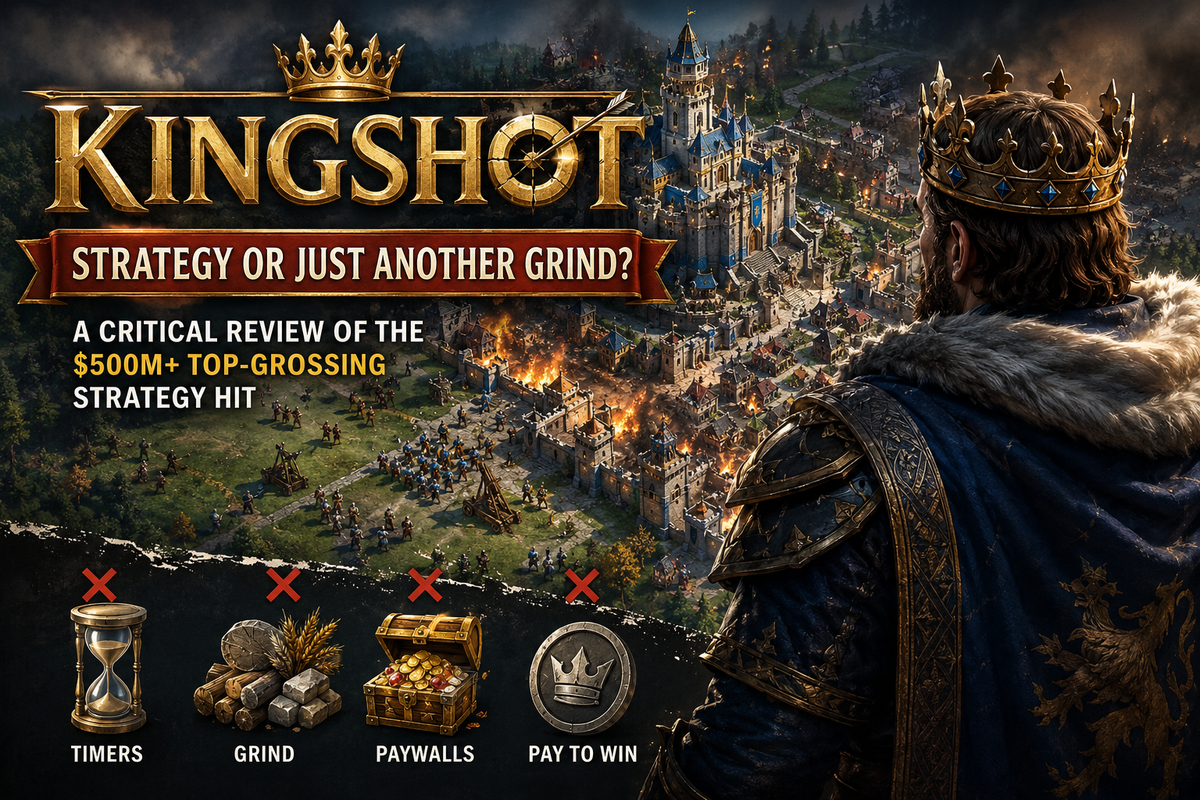
Kingshot is not sneaking up on anyone. As of June 28, 2026, AppBrain has it sitting at No. 5 among top-grossing Google Play games in the U.S., above Last War: Survival Game and Whiteout Survival, with a 4.3 rating and roughly 49 million installs listed on the ranking page. Google Play itself tags it as the No. 1 top-grossing strategy game. That is not a quiet hit. That is a siege engine parked outside the genre’s front gate. The question is whether Kingshot earned that position through actual strategic richness, or whether it is another timer factory wearing a fresh medieval helmet.
The answer: Kingshot has strategy, but not enough to escape the gravitational pull of the mobile 4X money machine. It is cleverer than the laziest reskins, slicker than most shovelware, and occasionally satisfying in that “I optimized three menus before coffee” way. But under the castle walls sits a familiar foundation: upgrade queues, hero power, alliance obligation, resource throttling, PvP pressure, and the old free-to-play sermon that patience is a virtue until someone else buys impatience by the crate.
Kingshot is a medieval survival-strategy game from Century Games, the same publisher behind Whiteout Survival. You play as a governor rebuilding a town after rebellion and collapse, rescuing civilians, feeding them, assigning jobs, expanding the settlement, upgrading defenses, recruiting heroes, researching technology, joining alliances, and clashing with other governors for resources and rank. The official description leans hard on survival management, laws, health, happiness, invasions, alliances, heroes, and technology, which gives it the shape of Frostpunk by way of a mobile war map.
The early hook is the best part. Kingshot adds a light tower-defense layer to the usual base-building runway: rebel waves attack, you fortify, you move a hero, you watch townsfolk and defenses chew through enemies. It is immediate, readable, and more tactile than tapping “upgrade farm” for the 800th time. AppGrowing’s breakdown notes that the real-time burden is limited, with most decisions made before battle and hero movement being the main active task during fights. That sounds about right for the design philosophy: enough control to feel awake, not enough to derail the monetization funnel.

Strategically, Kingshot is strongest when it asks small, practical questions. Which buildings matter now? Which heroes deserve scarce upgrade material? Do you push military power, economic growth, or alliance utility? Do you spend speedups during an event window or hoard them for a better scoring cycle? These are real decisions, and a disciplined free player can absolutely play better than a careless spender in the early and midgame. The game rewards routine, planning, and social coordination.
But that is spreadsheet strategy, not tactical mastery. Combat is mostly preparation plus power math. Hero composition and troop ratios matter, but they sit inside a structure where account strength, upgrade depth, and paid acceleration loom over every exchange. The battlefield rarely asks you to improvise. It asks whether you built the correct machine beforehand, and whether your machine has more numbers than the other machine.
The base-building layer is where the mask slips. Kingshot’s town has a pleasant toy-box quality, with civilians to manage and a darker medieval tone than the icy desperation of Whiteout Survival. Yet the rhythm is extremely familiar to anyone who has touched Rise of Kingdoms, Evony, State of Survival, Last War, or Whiteout. Upgrade the headquarters equivalent. Unlock dependency chains. Research buffs. Train troops. Collect idle output. Join an alliance for helps and rewards. Get nudged into recurring events. Watch wait times stretch. The setting changes, the UI shuffles, the hunger meter gets a costume, but the skeleton is the same.
That comparison is not incidental. Appfigures describes Kingshot as built on the same 4X strategy foundation as Whiteout Survival, with base building, resource management, hero collection, alliances, and PvP, while adding a tower-defense onboarding hook. It also reported that Kingshot reached more than $500 million in net revenue in its first 11 months after launching at the end of February 2025. In other words, this is not an experimental little strategy game that accidentally found an audience. It is a highly engineered successor to one of mobile’s biggest recent 4X successes.
Monetization is the dragon in the throne room. Kingshot is free-to-play viable in the narrow sense that you can download it, progress, join an alliance, participate in events, and feel busy without paying. It is not free-to-compete viable in the broader sense, especially once PvP and server hierarchy harden. The store listing itself discloses in-game purchases and emphasizes competition, alliances, rare items, rankings, and technology races. That combination is the genre’s pressure cooker: social obligation plus limited-time events plus ranking ladders plus resources that can be accelerated.
The pressure is not subtle. Timers become longer. Upgrade materials become more selective. Hero progression narrows. Event calendars train you to spend resources only when the game says they count, then tempt you to buy more when you run dry. The most dangerous purchase in Kingshot is not the huge whale bundle. It is the small “reasonable” pack that teaches your brain the first skip is harmless. After that, the game has you comparing hours of waiting against the price of lunch.
PvP and alliances are where Kingshot comes closest to real strategy. Diplomacy matters. Attendance matters. Rally timing, shield discipline, target selection, event preparation, alliance leadership, and inter-alliance politics can create stories no single-player campaign could script. A smart, organized alliance can punch above its raw power for a while. The social layer is the one part of Kingshot that genuinely breathes.
Still, the ceiling is money-colored. Once a server’s whale class establishes itself, strategy often becomes the art of serving, avoiding, or coordinating around spenders. That can be compelling in the same way office politics can be compelling, but let us not mistake it for balanced competition. The best alliance leaders are playing a strategy game. Many ordinary members are playing attendance software with swords.
Against its competitors, Kingshot sits in an interesting but not revolutionary spot. Rise of Kingdoms remains the more expansive map-war sandbox. Evony is messier, older, and more nakedly transactional. Last War has the sharper ad-friendly action gimmick. Whiteout Survival has the stronger thematic identity, with its cold-weather survival wrapper doing more atmospheric work than Kingshot’s generic medieval collapse. Kingshot’s advantage is polish and pacing. It onboards better than most of them. It gives you a more convincing first hour. It knows exactly when to hand you a victory chest.
That is also the trick. Kingshot is less a reinvention than a refinement of the modern mobile 4X funnel. The tower defense and survivor management touches are spices, not the meal. They make the first bites taste different, but the long-term diet is still timers, power growth, alliance events, and monetized impatience.

So, is Kingshot worth your time? For casual mobile players who enjoy alliance chatter, daily checklists, and incremental growth, yes, with strict spending discipline. It is polished enough to entertain, and the social game can become sticky in a way that no premium strategy title quite replicates.
Is it worth your money? For most players, no. Spending does not unlock a deeper strategy game. It mostly buys velocity, advantage, and relief from friction the game deliberately creates. Strategy enthusiasts looking for meaningful tactical decisions should treat Kingshot as a glossy curiosity, not a main course. Industry watchers should study it, because it is a brutally efficient example of where top-grossing mobile strategy has gone.
Verdict: 6/10. Kingshot is a well-made medieval wrapper around a familiar 4X grind. It offers moments of genuine planning and social strategy, but its deepest systems ultimately bend toward time pressure, power inflation, and the wallet.