Royal Match Review: The Puzzle King That Refuses to Be Dethroned
Royal Match may look like just another shiny match-3 puzzle game, but its staying power is no accident. Behind King Robert’s endless disasters is a finely tuned mix of polished puzzle design, relentless live events, smart monetization, and one of mobile gaming’s most effective marketing machines.
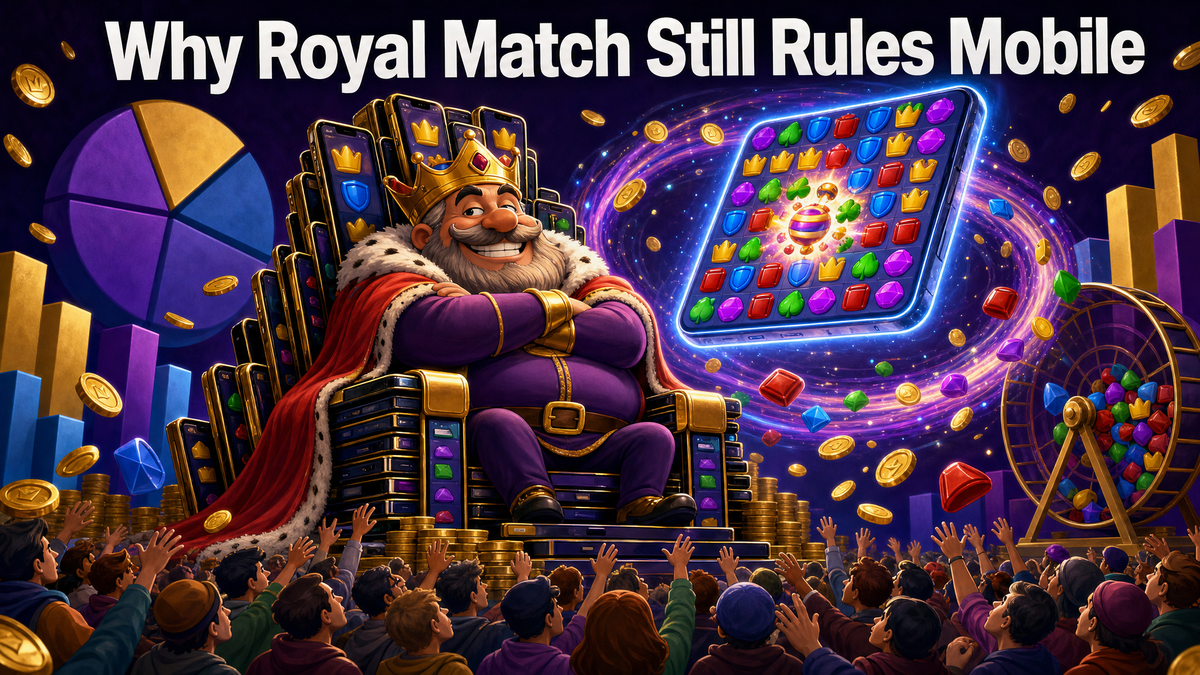
Dream Games’ match-3 giant looks simple from the outside. Inside, it is one of mobile gaming’s most carefully tuned machines.
There are blockbuster console games that would envy the staying power of a cartoon king trapped under falling debris. Royal Match launched globally in 2021, yet years later it is still sitting near the top of the mobile charts, often above louder, newer, flashier games with bigger worlds and more obvious gamer appeal. In 2025, it ranked third among the world’s highest-grossing mobile games, ahead of Candy Crush Saga on that list, while Mobilegamer.biz estimated its 2025 revenue at $1.37 billion.
That is the Royal Match paradox. To a core gamer scrolling past its ads, it looks like app store wallpaper: another match-3 puzzler, another cheerful mascot, another castle to renovate. But to dismiss it as merely another casual time-waster is to miss the craft. Royal Match is not popular because it reinvented match-3. It is popular because it understands, with almost alarming precision, how little friction a daily puzzle game can have before it becomes part of someone’s routine.
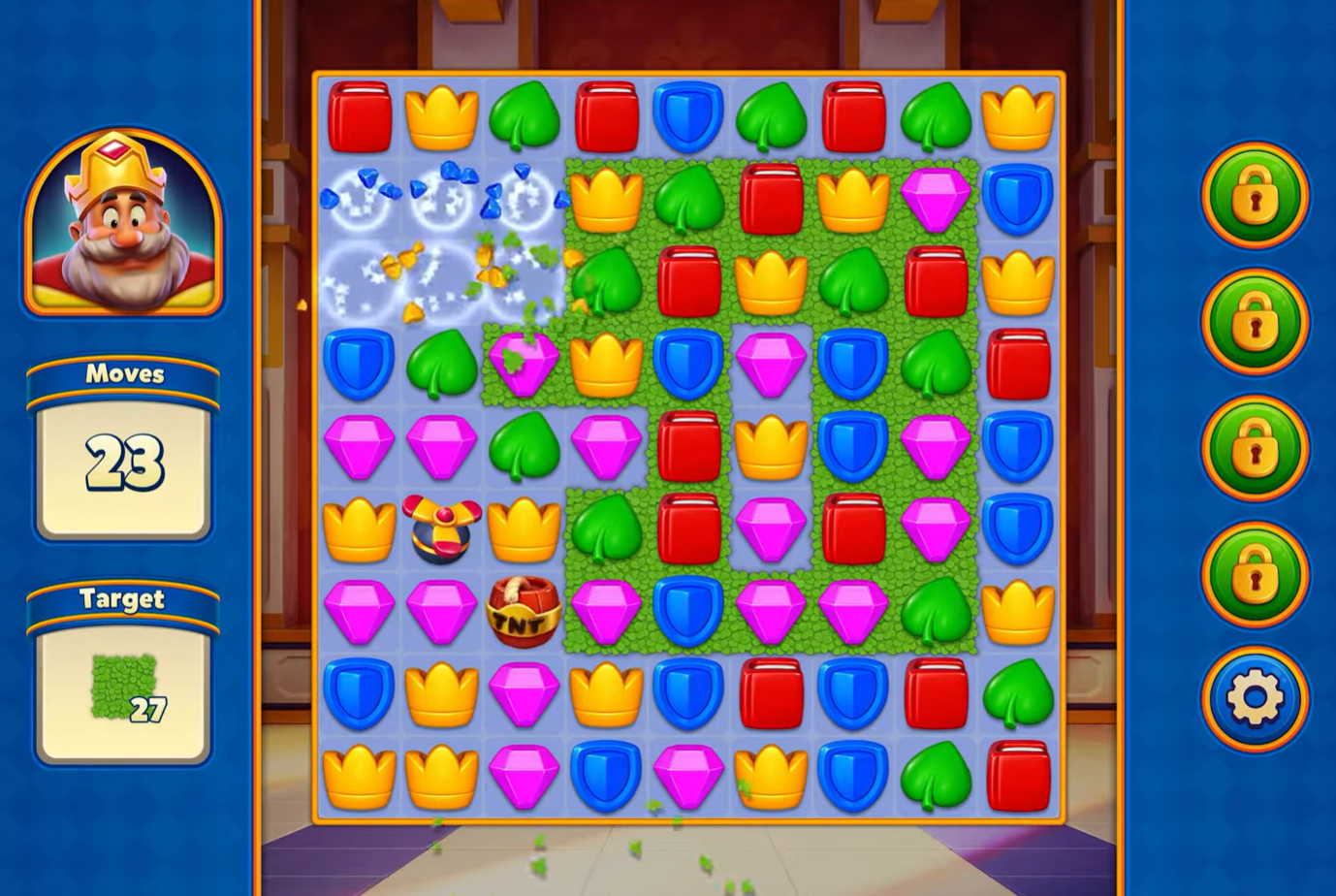
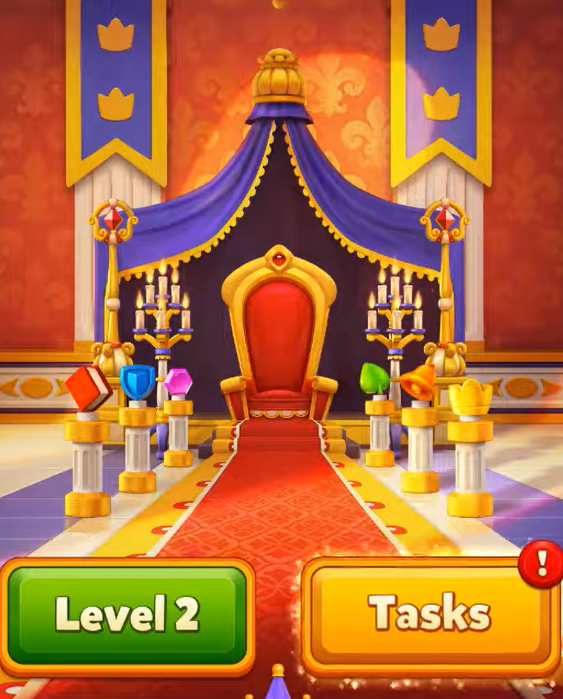
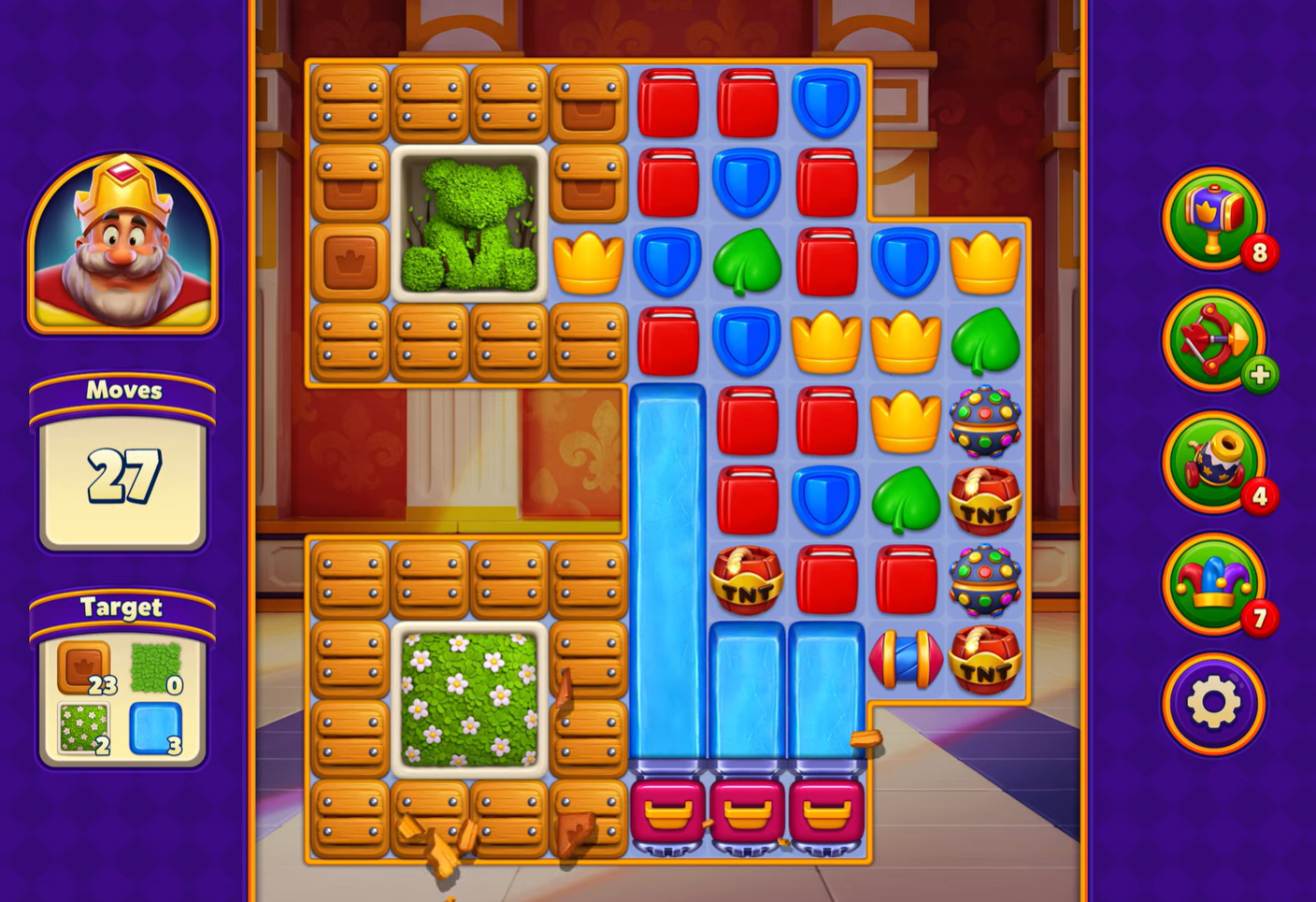
At the level of basic play, Royal Match is aggressively clean. You match crowns, books, shields, leaves, and other shiny castle-themed pieces, then use the usual family of boosters: rockets, TNT, propellers, and the all-important Light Ball. Dream Games’ own description highlights the King Robert setting, Winston the butler, Duke the dog, and a royal castle that expands through new rooms and areas as players progress. None of that sounds revolutionary. What matters is the feel. A rocket does not just clear a row; it snaps across the board with little theatrical confidence. A TNT detonation has the chunky pleasure of a bubble wrap sheet giving up all at once. Combine a Light Ball with a propeller and the screen briefly becomes a fireworks display with office-supply levels of organization.
This is where Royal Match earns more respect than skeptics might expect. The board is readable. The animations are fast but not noisy. The explosions are generous without becoming illegible. The game gives you the sense that you caused a glorious chain reaction, even when the algorithm quietly loaded the dice in your favor. That is not an insult. It is the central art of casual puzzle design: making luck feel like competence and competence feel like comfort.
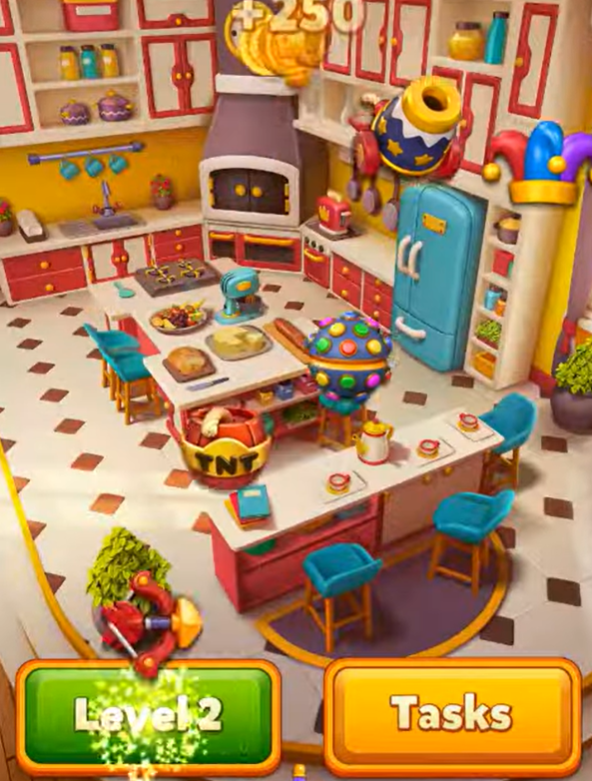
The difficulty curve is also smarter than it first appears. Early levels glide by, teaching the player that Royal Match is a place where progress happens. Then come the harder stages, the limited moves, the awkward blockers, the level where one stubborn vase or patch of grass survives with a single move left because of course it does. But the game rarely begins by making you feel stupid. It lets you build a habit before it starts tightening the screws. When it does get harder, it has already trained you to believe the next attempt might be the one.
That “one more level” pacing is the true campaign. The castle renovation is pleasant enough, but it is not the reason most people return. The real structure is a loop of small finishes: clear the board, open a chest, finish a task, earn a booster, climb a tournament, help a team, claim a pass reward. Dream Games’ help center lists a small empire of events and tournaments, including King’s Cup, Royal League, Team Battle, Royal Pass, Sky Race, Lava Quest, Hidden Temple, and more. Each event reframes the same core action just enough to make repetition feel like participation. You are not merely clearing level 2,813. You are collecting cups. You are protecting a streak. You are contributing to a team. You are almost at the next chest.
Then there is King Robert, Royal Match’s strange little cultural weapon. He is not a deep character. He is barely a character in the traditional sense. He is a reaction machine, a cheerful royal avatar designed to be dropped into peril, rescued, embarrassed, frozen, burned, flooded, or otherwise inconvenienced by the laws of mobile advertising. Royal Match’s ads famously leaned into the same “save the character” language that Homescapes and Gardenscapes helped make notorious. The difference is that Dream Games eventually folded those rescue scenarios into the game through King’s Nightmare, a feature industry analysis described as a way of implementing the abstract ad puzzles as level goals.
That matters because Royal Match’s marketing is not some side story. It is part of the product’s identity. Sensor Tower data cited by PocketGamer.biz in 2023 attributed much of its rise over Candy Crush to aggressive paid user acquisition, with 61.5 percent of Royal Match downloads coming through paid channels, and noted celebrity ad appearances from names including Tom Felton and Simon Cowell. The game became inescapable not because everyone organically whispered about the joys of matching royal shields, but because Dream Games bought attention at enormous scale and then had a game polished enough to keep enough of that attention.
The business model is similarly shrewd. Royal Match advertises itself as “100% ad free” on Google Play, which is both a marketing line and a significant design choice. Plenty of mobile games monetize by interrupting you. Royal Match monetizes by not interrupting you, then offering coins, boosters, extra moves, and pass-style rewards at the exact moment your patience is thinnest. That gives it a softer surface than many free-to-play games. You are not being shoved into video ads between attempts. Instead, the pressure arrives in the form of scarcity: lives, moves, streaks, boosters, and the sinking feeling that spending coins would rescue a nearly solved board.
This is also where the criticism belongs. Royal Match can be beautifully tuned and still exhausting. Its level design, while polished, inevitably starts to feel like remixing rather than discovery. New blockers arrive, new areas unlock, new event wrappers appear, but the fundamental rhythm remains the same: limited moves, layered obstacles, a board that may or may not give you the right cascade at the right time. At higher levels, the game’s generosity can feel conditional. The same systems that make it inviting also make it manipulative. You can play for free, but you are always aware that the store is waiting politely in the next room.
The lives system makes that pressure explicit. The official help page says players can have a maximum of five lives, lose one when they fail a level, and replenish one life every 30 minutes, with Royal Pass raising the cap to eight. That is standard mobile design, but standard does not mean invisible. For some players, the timer is a healthy stopping point. For others, it is the nudge that turns a five-minute break into a purchase decision. Royal Match is less predatory than the worst of the genre, but it is still built on the classic free-to-play bargain: comfort first, constraint later.
Its relationship with rivals is fascinating. Candy Crush Saga remains the genre’s elder monarch, broader in cultural recognition and still enormous. But Royal Match feels more modern in its surface discipline: no in-game ads, cleaner boards, tighter live-ops, and a marketing machine that understands TikTok-era repetition. Royal Kingdom, Dream Games’ follow-up starring King Richard, expands the royal universe and makes the company’s ambitions clearer. Google Play describes Royal Kingdom as a new match-3 adventure from the creators of Royal Match, built around King Richard, Princess Bella, the Wizard, and the Dark King. Dream Games is not treating Royal Match like a lucky hit. It is treating it like an IP platform.
The larger lesson is uncomfortable for anyone who still thinks “real gaming” mostly happens on consoles and PCs. Royal Match’s dominance says the modern market is not organized around spectacle alone. It is organized around habits. A prestige RPG may own a player’s weekend. Royal Match wants the elevator ride, the school pickup line, the couch after dinner, the three minutes before bed. It asks less, arrives faster, and rewards constantly. That is not a lesser design challenge. In some ways, it is a crueler one, because the game has to justify itself almost instantly, thousands of times, to people with no patience for tutorials, lore dumps, or loading screens.
So why is Royal Match still so popular? Because it is frictionless without feeling cheap, generous without forgetting to monetize, familiar without seeming dusty, and polished enough that even its most calculated tricks land with a satisfying pop. It turns match-3 into a daily ritual and King Robert into the world’s most profitable helpless monarch. The repetition is real. The monetization pressure is real. The ads are, depending on your tolerance, either genius or a minor public nuisance. But the craft is real too.
Verdict: Royal Match is not the most imaginative puzzle game on mobile, but it may be one of the most precisely engineered. It survives because it understands casual play better than most games understand their own audiences. Why this game? Because every tap feels good. Why now? Because mobile gaming rewards habit, polish, and relentless live service more than novelty. Why is it not going anywhere? Because as long as King Robert keeps falling into danger, millions of players will keep convincing themselves they have time for just one more rescue.