
WePlay Review: Karaoke Night in a Crowd You Can’t Quite See
WePlay wraps karaoke, drawing, deduction games, avatars, and live chat into a slick mobile party hub. It can be hilarious with friends, but open rooms, young users, and uneven moderation make its social chaos worth treating with caution.

WePlay is what happens when a party game app, a karaoke room, a Roblox-adjacent hangout, and a live voice-chat platform all crowd into the same booth and start ordering snacks. It is bright, loud, frictionless, and often genuinely fun. It is also not quite the cozy “friends on the couch” party-game experience the genre name might imply. The crucial thing to understand before installing it is that WePlay is not just a library of minigames. It is a social app built around rooms, microphones, avatars, gifts, and strangers.
The app in question is WEJOY PTE. LTD.’s WePlay, listed on mobile stores as “WePlay - Party Game & Chat” and “WePlay - Game and Party.” As of the current store listings I reviewed, one Google Play listing shows a Teen rating, 50M+ downloads, and about 1.3 million reviews, while another regional Android listing shows 10M+ downloads and about 287,000 reviews. Apple’s U.S. App Store listing shows a 16+ age rating and roughly 209,000 ratings. Those are store-level signals, not an audited player census, but they are enough to establish that WePlay has scale. WEJOY’s own January 2026 press materials go further, claiming more than 800 million global downloads, millions of monthly active users, and chart-topping performance across multiple regions. Treat that 800 million figure as company-supplied rather than independently verified, but it explains why the app has suddenly felt unavoidable in youth-oriented social gaming circles.
Behind it is WEJOY PTE. LTD., a Singapore-headquartered company founded in 2020, which has been pushing WePlay as a “voice + entertainment + connection” platform rather than a simple party-game bundle. Recent promotion has included Times Square billboard marketing and licensed character partnerships, which gives the whole thing the scent of a mobile social platform trying to graduate from app-store hit to youth-culture brand.
In practice, WePlay works less like Jackbox and more like a social lobby with games attached. You create or enter rooms, use voice and chat, customize a 3D avatar, invite friends or meet new people, and hop between modes. Third-party app-store mirrors describe sign-in through Google, Facebook, or phone, plus chat rooms, private messaging, and optional voice chat. The official listings foreground “voice interaction,” “new friends,” avatars, and room-based play, which is the real design center. This is not a party game that reluctantly added social features. It is a social app that uses party games as the icebreaker.
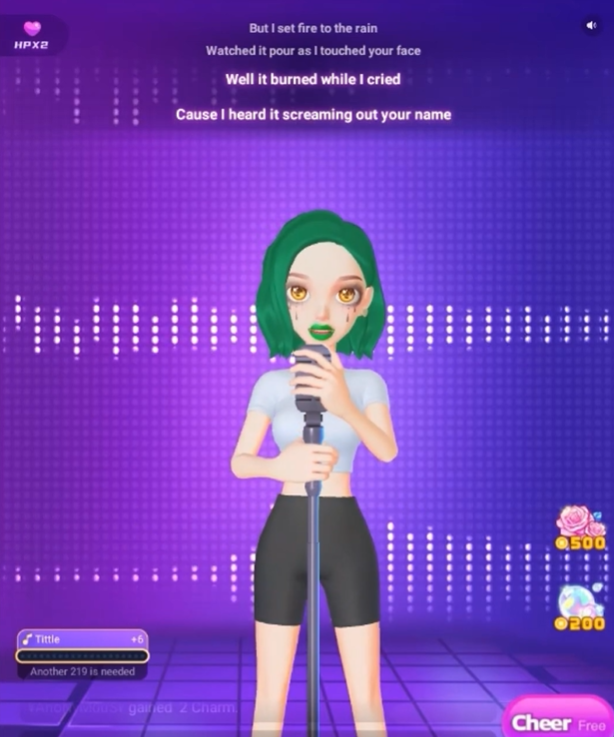
The best proof of concept is Mic Grab, WePlay’s karaoke-style mode. It is the app’s purest idea: someone takes the mic, sings, performs, jokes, or melts down theatrically while everyone else reacts. On a good night, Mic Grab is chaotic in exactly the right way. It understands that karaoke is not really about vocal quality. It is about the room deciding, collectively and instantly, whether someone is brave, funny, charming, or doomed. In friend groups, it can be terrific. With decent strangers, it has that loose late-night lobby magic that older internet users remember from voice-chat servers and MMO towns. With the wrong crowd, it turns into a middle-school cafeteria with reverb.
The rest of the library is broader than it is deep. Official listings call out Who’s the Spy, Guess the Imposter, Space Werewolf, Guess My Drawing/Draw & Guess, WeParty, Ludo, and avatar-driven hangout features. Public invite pages and third-party listings also point to assorted card, pool, challenge, and “voice room” activities. The social deduction games are the strongest after Mic Grab. Who’s the Spy and Space Werewolf work because voice chat gives lying a texture that text boxes never can. You can hear someone over-explain, panic, bluff, or get railroaded by a mob of suspicious twelve-year-olds. That is funny until it is exhausting. Public matches often live or die by whether the room culture is playful or feral.
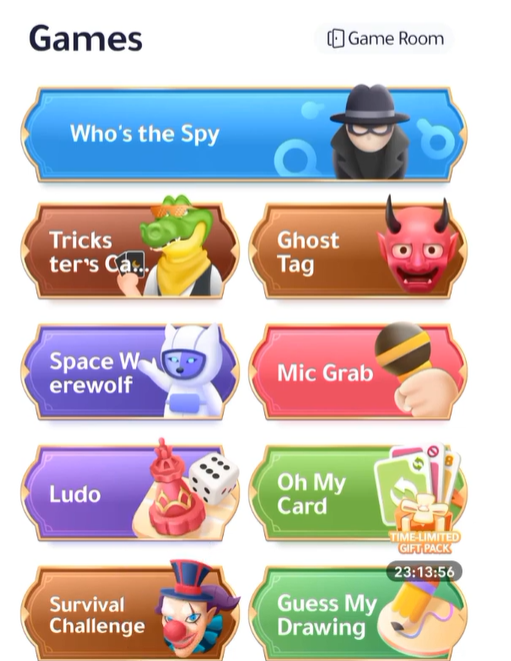
Guess My Drawing is the reliable crowd-pleaser. Drawing games are party-game comfort food because they survive language barriers and skill gaps. A terrible doodle is not a failure, it is content. WePlay’s version scratches that itch, but it lacks the curated comic timing of the best Jackbox drawing games. Its tools and flow are serviceable rather than elegant, and in open rooms the prompt quality and player-generated chaos can undercut the joke. Meanwhile, games like Ludo, pool, card modes, and light challenges add volume to the menu but not much identity. They are fine palate cleansers, not reasons to install the app.
Players coming in for polished trivia or tightly written voting comedy should adjust expectations. WePlay is not currently best understood as a trivia app, and I could not verify a flagship dedicated trivia mode from the official store copy I reviewed. Its “voting” energy mostly appears through social deduction, party-room dynamics, and accusation mechanics rather than a refined Quiplash-style questionnaire machine. In that sense, WePlay’s design philosophy is blunt but effective: do not write the joke, build a room where users might become the joke.
The user experience is impressively frictionless and occasionally maddening. Setup is easy, sessions are quick to enter, and the avatar layer gives the app a strong social toybox quality. The downside is clutter. WePlay throws rooms, badges, cosmetics, currencies, gifts, subscriptions, events, and game tiles at the player with the breezy confidence of a mall kiosk salesperson. It is free to download, but monetization is everywhere. Google Play labels it as containing in-app purchases, including random items, while Apple’s listing labels it as containing loot boxes, messaging/chat, user-generated content, and a long list of gold packs and other purchases. VIP subscriptions and virtual currency are not surprising in mobile social gaming, but they do make WePlay feel less like a clean party-game purchase and more like a live-service hangout with a cash register at every door.
Replay value depends almost entirely on who you play with. With a reliable friend group, WePlay has legs. Mic Grab, drawing, and social deduction can produce endlessly renewable nonsense. With randoms, it is a slot machine. Sometimes you get a charming international lobby and leave with three new friends. Sometimes you get shouting, harassment, children swearing into cheap microphones, or someone using the room as an audition for being kicked off the internet.
That brings us to the central issue: audience. WePlay’s official copy says it is a party app “young people” love, Google rates the Android listing Teen, and Apple rates the iOS listing 16+. Yet the app very clearly attracts children and younger teens. I could not find a trustworthy independent demographic breakdown, so any numeric claim about the share of underage users would be guesswork. But the evidence is hard to ignore: user reviews mention kids, teens, 12+ recommendations, under-16 settings, bedtime restrictions, and concerns about younger users hearing profanity or mixing with older players. These are anecdotes, not survey data, but they line up with the app’s own decision to publish youth-safety materials and minor-protection features.
WePlay does have safety policies. Its public materials state the service is not intended for children under 13, prohibit content harmful to child safety, and describe child-safety reporting and moderation systems. The company has also promoted “Youth Protection Mode 2.0,” launched in June 2025, with claims around age-based separation, risk alerts, anti-harassment protections, parental controls, and account governance. Those are the right categories. The problem is that WePlay’s product design creates a higher safety burden than a closed-room party game. Open lobbies, live voice, chat, gifts, avatars, user-generated content, and private social features are precisely the systems that need strong defaults, visible controls, and transparent enforcement.
For younger users, the risks are specific. Voice chat exposes them to adults and older teens in real time. Chat and private messaging can move a playful game interaction into one-to-one contact. Drawing and prompt-based games can surface sexual, hateful, or otherwise inappropriate content before moderation catches up. Gift economies can create weird social pressure, especially when status items and paid cosmetics are part of the room culture. Privacy is also not trivial: Google’s data safety section says the app may collect location, personal info, and other categories, while Apple’s privacy label says identifiers may be used to track users across apps and websites and lists purchases, identifiers, and usage data as linked to the user.
Compared with industry norms, WePlay is improving but not yet reassuring enough for unsupervised younger players. Jackbox, which is a very different product, offers tools like profanity filters, manual moderation, family-friendly settings, and player-kick options in supported games. Roblox and Discord, both closer to WePlay’s social terrain, have been moving toward stronger age assurance, teen defaults, family tools, and age-aware communication settings. That is the direction WePlay needs to chase aggressively: clearer parental dashboards, default friend-only play for minors, stricter mic gating, host moderation tools, prompt maturity filters, and plain-language explanations of what Youth Protection Mode actually does in the room, not just in a policy page.
To be clear, I found no reliable, independently reported WePlay-specific criminal case in the sources reviewed. The safety concern here is not a sensational claim that WePlay is uniquely dangerous. It is that the app sits in a category law enforcement and child-safety experts already warn about: online games and social platforms where adults can contact minors through chat, voice, and shared play. The FBI has warned broadly that predators use online gaming environments to sexually exploit children. WePlay’s design includes the exact social surfaces that make such warnings relevant.
Verdict: 3.5/5
WePlay is a messy, energetic, occasionally brilliant party platform with one killer instinct: it knows that the funniest party game is often just putting people in a room and giving them a microphone. Mic Grab is the headliner, the drawing and deduction games are sturdy, and the avatar-social layer gives the app a stickiness that many cleaner party games lack. But its strengths are inseparable from its risks. This is a live social app with games, not a toy you should hand to a child because the icon looks bubbly.
For adults, older teens, and friend groups who want a free, fast, voice-first party hub, WePlay is easy to recommend with caveats. For younger teens, it should be supervised and locked down as much as the app allows. For children, especially unsupervised children, approach with serious caution. The party is real. So is the crowd outside the door.