Whiteout Survival Review: Strategy, Survival, and the Tyranny of the Timer
Whiteout Survival wraps real alliance strategy and hero planning inside a slick mobile grind of timers, speed-ups, and pay-to-progress pressure. It can be smart, social, and addictive, but the shop button is never far from the battlefield.
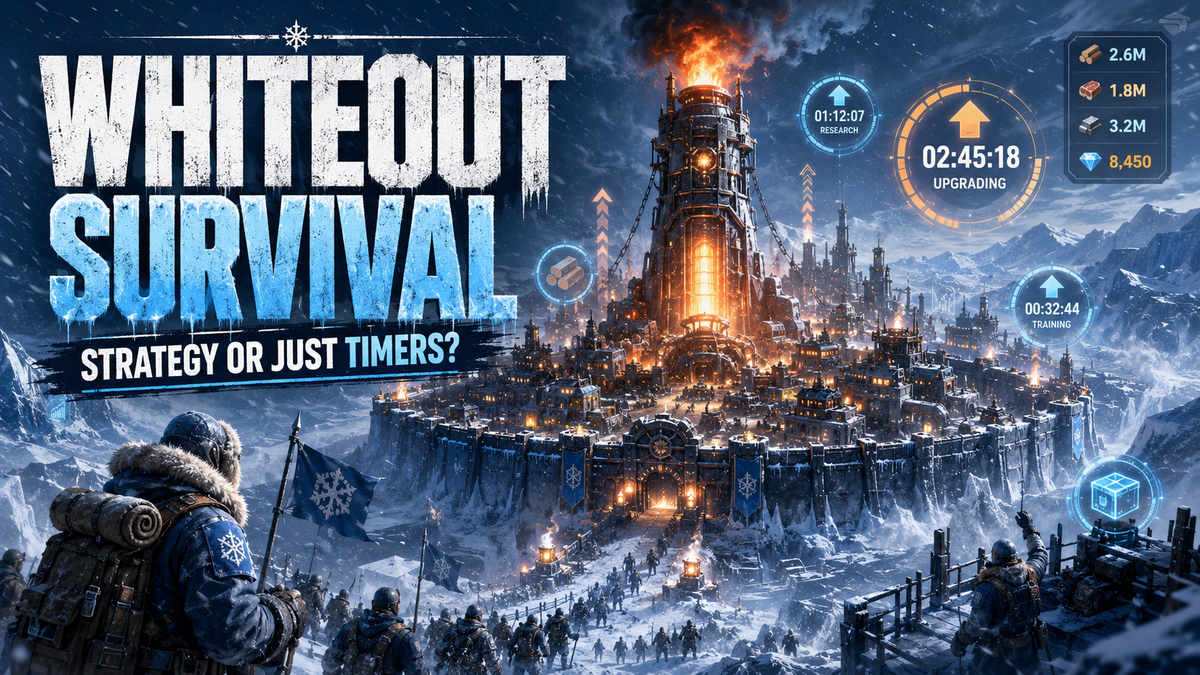
Whiteout Survival sits in a strange, lucrative corner of mobile gaming: a game dressed like a survival sim, structured like a 4X strategy title, paced like an idle clicker, and monetized like a casino that hired a UX designer. It is not some obscure curiosity, either. Century Games’ frozen city-builder has become one of the biggest mobile games in the world, ranking among the top-grossing mobile titles globally in recent revenue charts.
That success is not hard to understand. Whiteout Survival is slick, generous at first, socially sticky, and constantly busy. The question is whether all that activity adds up to real strategy, or whether the game is mostly asking players to tap glowing buttons while waiting for the next timer to expire.
The answer is: both. But not equally.
Welcome to the End of the World, Please Upgrade Your Furnace
Whiteout Survival begins with a simple, evocative premise. The world has frozen over, and your tiny settlement survives around a giant Furnace, the glowing heart of your city. You build shelters, gather resources, assign survivors to work, train troops, recruit heroes, and slowly transform a desperate outpost into a militarized snow kingdom. The official store listing pitches it as a winter-themed survival strategy game with hundreds of millions of players, and the setup does have immediate appeal.
At its best, the city feels pleasingly tactile. Buildings thump into place. Survivors trudge through the cold. The Furnace gives the base a strong visual center, which is more than many mobile strategy games manage. Whiteout Survival understands the satisfaction of making numbers go up, but it wraps that compulsion in unusually polished presentation.
The problem is that the early survival fantasy gradually gives way to a very familiar mobile 4X machine. Upgrade the Furnace. Upgrade prerequisites. Train more troops. Research more bonuses. Collect from the same menus. Claim from the same event tabs. Repeat until the game starts asking whether your patience is really patience, or just unpaid labor.

Where the Strategy Actually Lives
There is real strategy in Whiteout Survival, especially once the game opens beyond basic city management. It is just not always where the game’s busiest screens suggest it is.
Hero deployment matters. You are not simply choosing your highest-power units and calling it a day, at least not if you care about efficiency. Exploration uses a five-hero formation, typically two up front and three in the back, so positioning and hero roles matter in a way that is immediately legible. The official guide material even separates early-game and later-game lineup recommendations, reflecting how formation choices shift as hero access improves.
Expedition and rally play add another layer. Heroes are not only combat avatars, they are delivery mechanisms for buffs. In rallies, the captain’s three-hero squad can determine the bonus buffs granted to joining members, which means that alliance warfare has a tactical language beyond raw power totals. A smart player learns which heroes matter for leading, which matter for joining, and which are mainly there because the upgrade economy blessed them first.
Chief Gear is another meaningful long-term system. It improves troop performance directly, and its materials come from specific activities like Polar Terror rallies, beast hunting, Crazy Joe, Frostfire Mine, and alliance shops. That means progression is not just “spend everything everywhere.” You have to decide which stat lines and upgrade paths matter for the role you actually play in your alliance. A rally leader, a trap filler, a free-to-play support player, and a spender trying to dominate castle fights are not playing exactly the same optimization game.
Research is similarly strategic when resources are tight. Growth, battle, economy, and troop priorities compete for limited time and materials. The trap is obvious: the game encourages constant upgrading, but the stronger play is often selective upgrading. A player who blindly chases every red dot will look busy. A player who understands event timing, alliance needs, troop composition, and resource bottlenecks will grow more intelligently.
This is where Whiteout Survival is at its most interesting. The best decisions are not dramatic, cinematic commands. They are planning decisions. Saving speed-ups for an event. Holding resources before State of Power. Choosing whether to push Furnace level or strengthen combat stats. Coordinating alliance rallies instead of wasting marches. These are the choices that separate a competent governor from a very well-decorated button presser.

Alliance Warfare Is the Real Game
Whiteout Survival becomes much more compelling when treated less like a solo city-builder and more like a social war machine. Alliance play is where its design finally breathes.
Events like Canyon Clash turn the game into a territorial contest, asking alliances to occupy buildings, fight over routes, and secure key fortresses as the battle progresses through stages. That structure gives the game something precious: geography. Suddenly, power is not just a number on a profile. It has to be pointed somewhere. Players need timing, coordination, reinforcement discipline, and enough shared understanding not to fling their best marches into a meat grinder.
State vs. State events push that further. Matchmaking considers factors such as state strength, kills, past event performance, and activity, according to official guide material, which underlines how much the game’s biggest conflicts are built around collective strength rather than isolated account growth. In these moments, Whiteout Survival resembles the genre at its best: political, social, tense, and occasionally ridiculous.
And this is also where the game’s monetization starts putting its thumb on the scale.
The Timer Is the Real Final Boss
Whiteout Survival is full of strategic systems, but nearly all of them are wrapped in waiting mechanics. Build timers. Research timers. Training timers. Healing timers. March timers. Event timers. Timers that unlock other timers. Timers that exist mostly to make speed-ups feel like oxygen.
This is standard mobile strategy design, but Whiteout Survival executes it with ruthless confidence. The early game rains rewards on you. You upgrade constantly, unlock systems quickly, and feel clever because everything is moving. Then the cadence changes. Upgrades stretch. Requirements stack. You stop asking “What should I do next?” and start asking “What can I afford to finish today?”
That shift matters because it changes the nature of strategy. In a traditional strategy game, friction usually creates decisions. In Whiteout Survival, friction often creates monetization pressure. The game is at its smartest when scarcity forces prioritization. It is at its worst when scarcity simply makes the best move obvious but slow, unless you pay.
There is a difference between strategic restraint and being made to watch concrete dry.
Monetization Distorts the Battlefield
The elephant in the frozen room is money. Whiteout Survival is free-to-play, but its economy is built around pay-to-progress pressure. Spending can accelerate construction, research, hero development, VIP benefits, gear materials, charms, event rankings, and combat readiness. In a game where power determines who wins rallies, holds buildings, survives attacks, and earns better rewards, faster progression is not cosmetic. It is power.
This does not mean free players have no role. They absolutely do. A disciplined free-to-play player can be useful, especially inside a strong alliance. They can specialize, join rallies properly, save for events, contribute to objectives, and avoid waste. Whiteout Survival gives enough daily rewards and event loops to keep non-spenders involved.
But let’s not pretend the playing field is level. A free player is often playing logistics and patience. A whale is playing force projection. The free player asks, “How do I make the most efficient choice with what I have?” The spender asks, “Which advantage do I want immediately?” Those are different games sharing the same snow map.
The hero system is a major part of this tension. Hero collection and progression carry a gacha flavor, with shards, rarity, star levels, and gear all feeding into combat strength. Formation choices matter, yes, but access matters more. The cleverest lineup theory in the world does not fully compensate for being outspent by someone whose heroes and gear have simply crossed a different statistical border.
That is Whiteout Survival’s central contradiction. It contains strategy, but its business model sells relief from strategic limits.
What It Gets Right
For all that, Whiteout Survival is not a lazy game. It is polished in ways that matter.
The presentation is strong. The frozen aesthetic gives the city a clear identity, and the Furnace is a clever focal point. The interface is crowded, as these games always are, but it is readable enough to keep the loop moving. The feedback is excellent: upgrades pop, rewards cascade, power rises, troops march, and the city gradually looks like something you built rather than a menu you endured.
The alliance design is even better. Good alliances create obligations, rivalries, jokes, grudges, and a reason to log in beyond personal progression. The social layer gives the game most of its emotional stakes. You may forget which building upgrade took eight hours. You will remember the alliance that betrayed a fortress agreement or the rally that landed with three seconds to spare.
Whiteout Survival also understands pacing better than many competitors. There is nearly always something to claim, check, join, or prepare for. That can be exhausting, but it is also why the game is dangerous. It rarely feels empty. It keeps one hand on your shoulder and the other near your wallet.
Verdict: Strategy Under Ice
So, how much real strategy is there in Whiteout Survival?
More than skeptics might assume, and less than the game wants its biggest spenders to believe.
The genuine strategy lives in alliance coordination, event timing, hero usage, formation choices, gear priorities, research planning, and resource discipline. The shallow loop lives in the endless red-dot maintenance, timer management, VIP nudges, gacha progression, and upgrade treadmill that too often substitutes patience for play.
Whiteout Survival is at its best when it makes you think like a commander: where to send troops, when to save, which heroes to build, what your alliance needs, and whether today’s short-term gain will cost you tomorrow’s event. It is at its worst when it makes you feel like a clerk in a very cold office, stamping forms until the next construction queue opens.
The result is a polished, socially potent mobile strategy game with real tactical and organizational depth, trapped inside a monetization structure that constantly tries to sell you shortcuts through its own design. Play it with a good alliance and a disciplined approach, and there is a sharp, satisfying strategy game buried in the snow. Play it as a race to the top, and you may discover the real survival challenge is not the blizzard. It is the shop button.